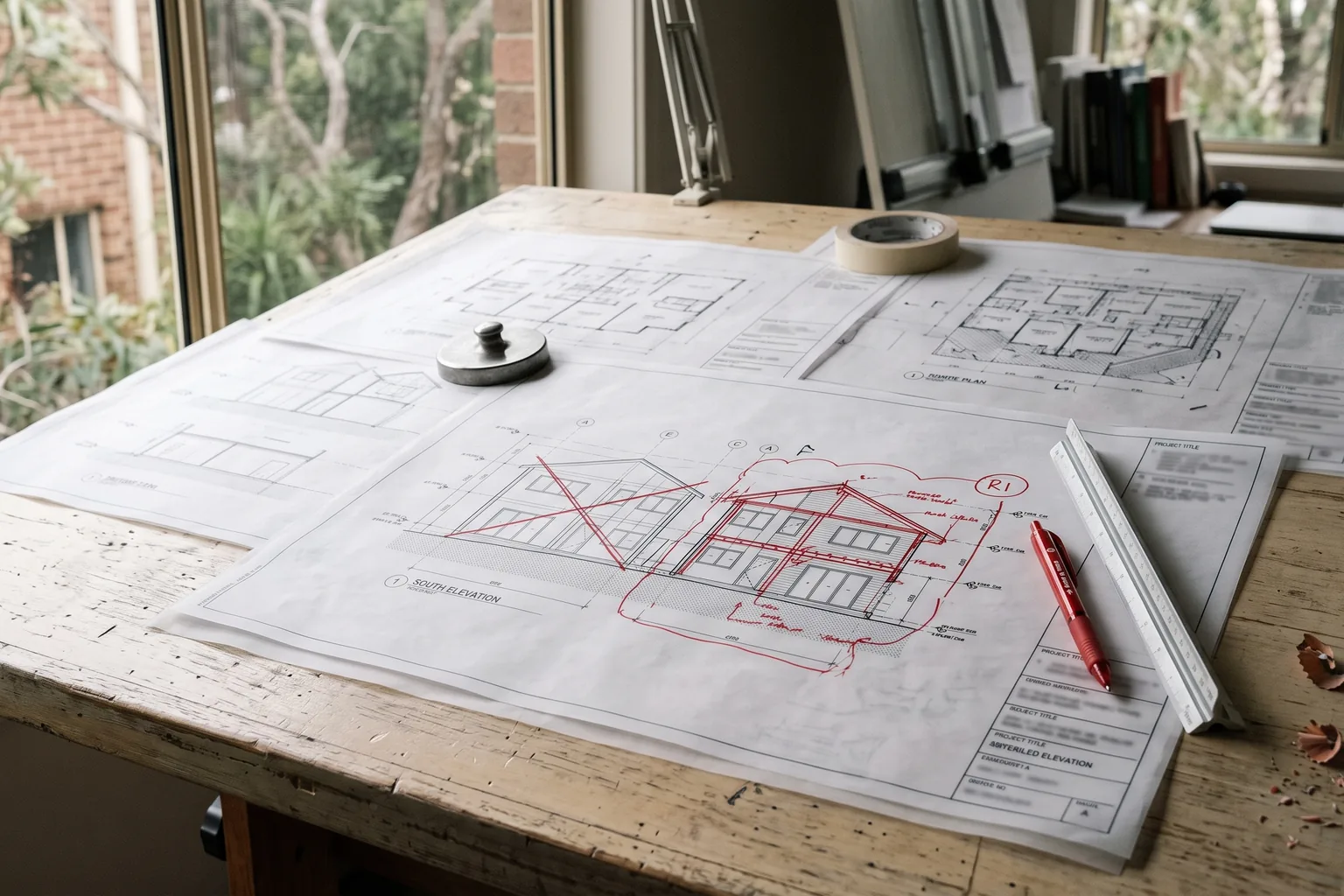
Almost every project changes between consent and construction. Section 4.55 of the EP&A Act is the machinery for that, and it has four doors, not one. Which door you are standing at is decided by the size of the environmental consequence and by a test most owners have never heard of, and the door you pick decides whether the change takes a fortnight or half a year.
The question arrives in almost the same words every time. We've got the DA. Can we just change it?
Yes. Usually. The expensive word in that sentence is "just".
A caller last year had consent for three townhouses on a deep block behind an existing house. His builder had priced the job and come back with a redesign: same three dwellings, same footprint area, but the garages pulled to the front, the roof form altered to lift ceiling heights, and the driveway shifted about two metres to avoid a retaining wall the builder didn't like the look of. His question was whether that meant a phone call to the duty planner or something bigger.
It was something bigger. It ran as a section 4.55(2) application, took a bit over four months, and one of the three dwellings came out of it a room smaller than the builder had drawn. Not a disaster in the end. But he'd already signed a construction contract on the assumption that the change was administrative, and those four months sat entirely on his side of the ledger.
That gap, between how significant a change feels to the person making it and which statutory pathway it actually lands in, is where most of the pain in this area lives. So here is the machinery.
Four doors, not one
Section 4.55 of the Environmental Planning and Assessment Act 1979 is the entire framework for changing a development consent after it has been granted. The department's practice note on section 4.55 describes it as setting out "the available modification pathways, including processes for correcting minor administrative errors, modifications with no or minimal environmental impact, other modification applications, and applications determined by the Land and Environment Court".
Four doors. Which one you're standing at is decided almost entirely by the size of the environmental consequence of the change, and not at all by how minor the change looks on a drawing. A two metre driveway shift can be a bigger door than a full internal replan, because one of them touches the ground and the neighbours and the other doesn't.
Worth saying up front, because it saves a lot of argument: the framework was amended in 2025, and the practice note that explains it is recent. If you're reading an older article, or working off advice a consultant gave you in 2023, some of what follows will be new to them.
4.55(1): the small door, and the new clock behind it
The first pathway covers two quite different things that happen to share a subsection.
The first is genuine administrative repair. Minor errors, misdescriptions and miscalculations. The practice note gives the examples: typographical or clerical errors, incorrect references to plans or documents, arithmetic or drafting errors in conditions of consent. If a condition refers to Drawing DA-04 Rev C when the approved drawing was Rev D, this is the door.
The second is more interesting, and it's the part the 2025 reforms opened up. A modification can also go through 4.55(1) where the consent authority is satisfied it will have no environmental impact. The practice note is unusually direct about what that means. The modification "must not introduce any new negative environmental impacts, including increases to the severity or distribution of an existing environmental impact". And then the line that decides most of these applications:
This pathway is a threshold test, not a balancing exercise. If any new environmental impacts arise, the modification cannot proceed under section 4.55(1), even if it would result in improvements overall, or in other areas.
Read that twice if you're planning to argue that your change makes the project better. Better is not the test. Better is a perfectly good argument in the other two pathways and it is completely irrelevant here. A change that improves solar access to a neighbour but shifts a bin store two metres closer to a boundary has introduced a new impact, and it is out of 4.55(1) no matter how favourable the balance looks.
The compensation for that strictness is speed, and the 2025 reforms sharpened it considerably. Section 4.55A now establishes a deemed non-refusal framework for 4.55(1) applications. The consent authority must determine the application within the prescribed period, which is 14 days after lodgement. If it doesn't, it must determine the application as soon as practicable afterwards and must not refuse it.
That is a genuinely unusual provision in NSW planning law, and it's worth understanding what it does and doesn't give you. It does not prevent conditions being imposed. But where conditions are imposed after the 14 days have expired, the practice note says they must relate only to the modification application and must not defeat its purpose. The council can't run out the clock and then condition your change into uselessness.
One carve-out to know about if your consent carries one: the deemed non-refusal framework doesn't apply to applications seeking to modify a housing and productivity contribution condition imposed under section 7.28, unless the modification has been approved by the Minister.
4.55(1A) and 4.55(2): where the volume knob sits
The other two local pathways are separated by a single question, which is how much environmental impact the change produces.
Section 4.55(1A) is for modifications of minimal environmental impact, where the development as modified would also be the same or substantially the same as what was originally approved. The practice note reads "minimal" in its ordinary sense, as very small or negligible, and makes one clarification that does more work than it looks. The minimal-impact requirement "qualifies the nature and extent of the impact, rather than the scope and scale of the modification itself". Those are two separate constraints. A physically large change with genuinely negligible impact can still be a 1A. A tiny change with a real impact can't.
Section 4.55(2) is what you use when the change produces more than minimal impact but the development still passes the substantially-the-same test. This is the workhorse, and it's where my caller's townhouses ended up. A 4.55(2) is assessed much like a development application: it's notified where the instrument requires it, neighbours can put in submissions, and a planner forms a judgement.
That leaves the test that decides all of this.
"The same or substantially the same", and the trap inside it
Every modification under 1A or 2 has to clear the same hurdle. The development, as modified, must be the same or substantially the same as the development that was originally approved.
The practice note gives the meaning as "essentially or materially having the same essence", and then sets out how the comparison is run. The onus sits with the applicant to demonstrate it. But it's the consent authority that has to be satisfied, on balance, as a matter of overall planning judgement. The comparison may pick up quantitative differences like height, gross floor area and setbacks, and qualitative ones like land use, configuration and amenity. Crucially, the mere presence of differences is not enough to fail the test. What matters is "the nature, extent and effect of those differences".
That's a more forgiving test than most owners assume, and consultants who've been burned once tend to undersell it.
Now the trap, and it's the single most useful sentence in the practice note for anyone planning more than one change:
To determine whether it would be the same or substantially the same, a comparison must be made between the development originally approved (not the development as modified) and the development as proposed to be modified.
The benchmark never moves. It is always the original consent.
Think about what that does over the life of a project. Three modifications, each of them modest, each of them comfortably substantially the same as the thing immediately before it, can collectively drift far enough from the original that the fourth one fails, and it fails on the accumulated distance rather than on its own merits. I've seen a scheme reach that point and the owner was genuinely baffled, because the change he was asking for was smaller than the two the council had already approved. Serial modification is not a free ride. It spends a budget you can't see.
What a modification assessment is not
Here's the counterweight, and it's the reason a modification is usually worth trying before a fresh application.
Section 4.55(3) confines what the consent authority may consider. It must have regard to the section 4.15(1) matters, but only to the extent those matters are relevant to the proposed modification, and to the reasons given for the original consent, again only where relevant. As the practice note puts it, this "ensures that the assessment remains focussed on the impacts and planning considerations raised by the proposed modification, rather than reopening or reassessing the merits of the approved development as a whole".
That is a real protection and it's worth knowing you have it. A modification is not an invitation for a council to revisit a consent it wishes it hadn't granted. If an assessment officer starts asking questions about elements of your approved scheme that your modification doesn't touch, that's the provision to point at.
Two related points that catch people. Section 4.55(5) confirms that a consent can be modified where the change involves no physical alteration at all, so condition-only modifications are squarely available and get assessed on their merits. And section 4.55(3B) makes clear that where an environmental planning instrument requires notification, consultation or concurrence, section 4.13 continues to apply to 1A and 2 modifications. You cannot use the modification process to route around a referral. If your original consent needed a bush fire safety authority or a water authority sign-off, a modification touching that ground will need to go back through the same body.
Timeframes, honestly
The only firm number in this area is the 14 days for a 4.55(1), and that number is firm because section 4.55A hangs a consequence off it.
For 1A and 2 applications, there is no promised turnaround. What exists is the deemed refusal clock, which for a modification application generally runs at 40 days, the same period as an ordinary development application. That is not a service standard. It is the point at which you acquire a right of appeal, which is a different thing entirely and is covered in more detail in the piece on deemed refusal and the Land and Environment Court.
In practice, a 4.55(2) on a residential project behaves like a small DA. My caller's took a bit over four months. I've seen straightforward ones done in six weeks and contested ones run past six months, and the variable is usually whether the change attracts submissions rather than anything about the change itself. Anyone quoting you a confident number without having read the file is guessing.
When a fresh DA beats a modification
Three situations where I'd stop trying to modify and lodge again.
The first is when the change fails the substantially-the-same test, and this is a threshold rather than a slope. A modification that can't clear it doesn't get approved slowly, or with conditions, or with more consultant reports. It cannot be approved at all under section 4.55. If your redesign changes the land use, or converts four dwellings into seven, or turns a dual occupancy into a residential flat building, you're not modifying. You're proposing a different development, and the months spent finding that out through a modification application are months you never get back.
The second is when the planning controls have moved in your favour since the consent was granted. NSW has had an unusual run of housing reform, and a site that was approved for a compliant scheme under the old standards may now be able to carry considerably more. A modification is anchored to the original approval by definition. A fresh application isn't anchored to anything except the current instruments. If the ceiling has risen, modifying up to the old ceiling is the wrong move.
The third is commercial rather than legal. If you're selling, what a buyer is pricing is the scheme, not the paperwork, which is the argument running through selling a property with DA approval. A clean consent for the scheme the market wants is worth more than an original consent plus a pending modification for the scheme the market wants. Pending is a risk the buyer discounts, and they discount it harder than the actual probability warrants.
The one thing I'd add against all three: a modification keeps the existing consent alive while it's being considered, and a fresh application does not come with any guarantee that you'll get back what you already hold. On a site where the approved scheme is genuinely valuable, that asymmetry is worth weighing before anyone gets clever.
Questions worth settling before you lodge
Can a modification be refused for reasons unrelated to the change?
It shouldn't be. Section 4.55(3) limits the consent authority to the section 4.15(1) matters that are relevant to the proposed modification, and to the reasons given for the original consent to the extent they're relevant. The practice note frames this as keeping the assessment proportionate and avoiding re-assessment of the whole development. In the real world, an officer who dislikes the approved scheme will sometimes test the boundary of that, usually by requesting information that has nothing to do with the change. The answer is to ask, in writing and politely, which aspect of the modification the request relates to. It resolves most of them.
Does the council have to notify the neighbours about a modification?
It depends which pathway you're in and what the instrument says. Section 4.55(3B) provides that section 4.13 applies to modifications under 1A and 2 where an environmental planning instrument requires notification, consultation or concurrence, so those requirements carry across rather than being avoided by using the modification process. A 4.55(1) is a different animal, because it's confined to administrative repair and changes with no environmental impact, which is precisely the category where there's nothing for a neighbour to be consulted about.
Can you modify a consent that the Land and Environment Court granted?
The provisions extend to the Court. Section 4.55(8) enables the Court to modify a consent it has granted, and where the Court determines a modification application it exercises the modification power itself. The practice note adds one wrinkle worth knowing: the statutory functions around notification and the consideration of submissions still have to be exercised by the relevant consent authority rather than by the Court. So the council still runs the notification even where the Court makes the decision.
Is a modification cheaper than a new DA?
Usually, and sometimes by a wide margin, because you're not re-running the assessment of the whole development or re-commissioning the full suite of reports. But the saving is real only when the modification is the right instrument. A modification that fails the substantially-the-same test after four months of assessment costs you the modification fee, the consultant time, four months of holding cost, and then the fresh application anyway. That's the calculation to run before lodging, not after, and it's the same discipline that runs through the feasibility on everything else.
What if the builder has already started?
Then you're building something the consent doesn't cover, and the consequences arrive at occupation stage rather than immediately, which is what makes it dangerous. Work outside the terms of a consent isn't cured by a modification lodged afterwards, although a modification is usually part of how it gets resolved. The sequence that works is design change, then modification, then build. The sequence that ruins programmes is build, then discover, then modify under pressure with no leverage.
PropertyThrive reads consents for a living. If you're holding a DA and wondering whether the scheme you actually want is a modification, a fresh application, or a different project altogether, we'll tell you which, and where the substantially-the-same line sits on your particular consent. It's free and there's no obligation. Book an assessment and you'll have the read back within 24 hours.
Ready to get started with developing a property?
Get your development assessment or speak with our development experts today
24-Hour Response Guarantee
Submit your details and receive your preliminary development assessment within 24 hours, guaranteed.
No Obligation, Completely Free
Our assessment and initial consultation are completely free with no strings attached. Only proceed if you're 100% happy.
Strategic Development Partnerships
Partner with us to maximise development potential through joint ventures, profit-sharing, or direct acquisition options.