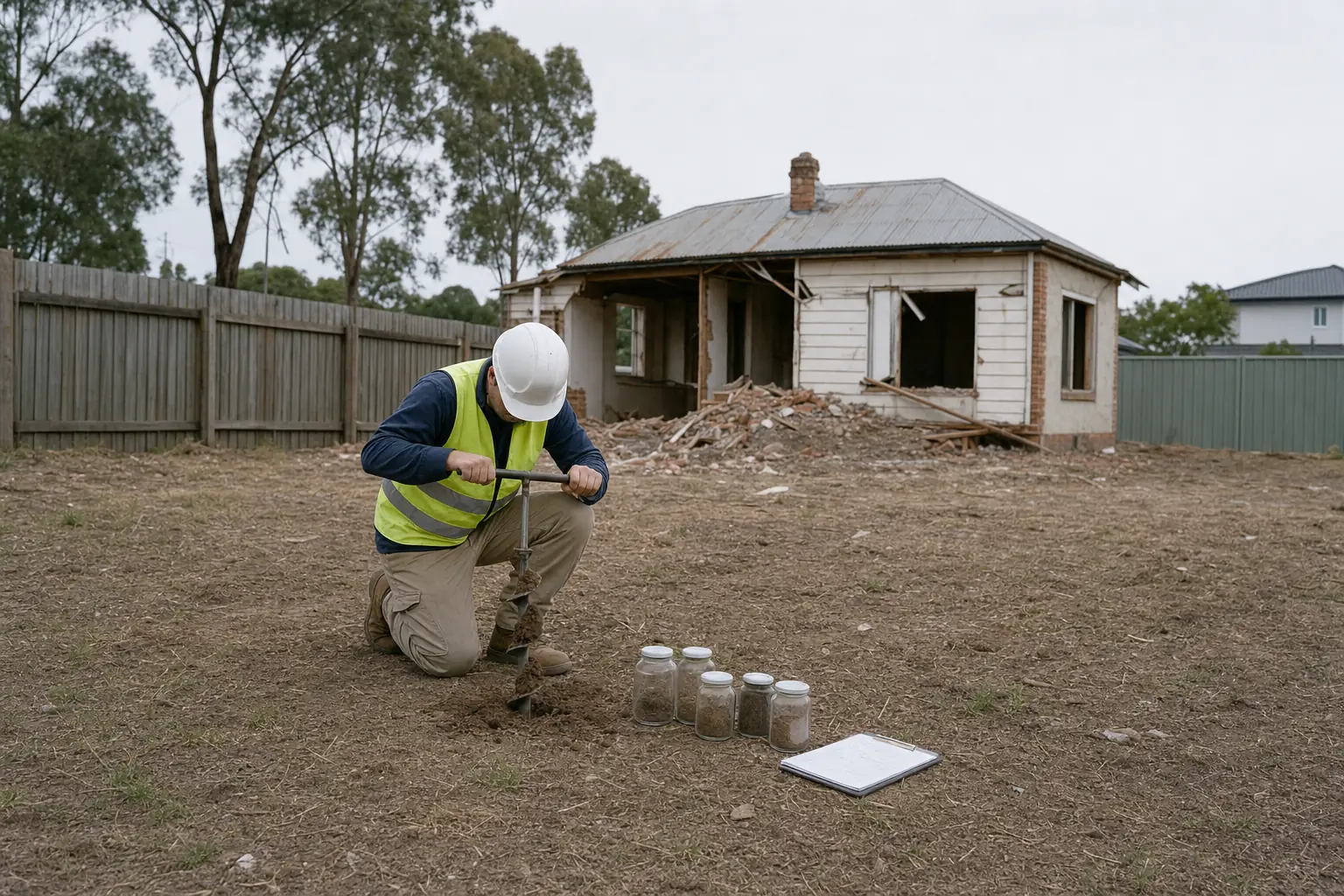
A council can refuse your development application for all sorts of reasons. Contamination is different in kind: until the consent authority has considered it and satisfied itself the land is suitable, it has no power to approve anything at all. Which is why this question kills projects late, expensively, and almost always on sites the owner thought were ordinary.
The bloke had done everything in the right order, which is why it stung.
Corner block in the Illawarra, inherited from his father, DA lodged for four townhouses. Survey done, plans drawn, arborist report in, a planner he'd paid properly. Month four of the assessment, a request for additional information lands: council wants a preliminary site investigation, because the aerial photography from 1972 shows a shed at the rear with a hardstand apron and a vehicle turning circle, and the council's own records have the property flagged as a potential former workshop.
It had been his father's mechanical workshop. Ran until about 1991. He'd told nobody, not because he was hiding it, but because it genuinely had not occurred to him that a shed his dad had swept out every Friday for twenty years was a planning matter.
The investigation came back the way those investigations usually come back on a workshop site: nothing catastrophic, a hydrocarbon signature around where the drums had sat, enough to require a detailed investigation and then a remediation action plan. The project survived. It survived about nine months later than planned and with a line in the budget nobody had written down at the start.
I've watched this sequence enough times now that I go looking for it before anything else. Not because contamination is common — most residential blocks are clean — but because of where it sits in the legal machinery, which is a place almost no owner understands.
This is not a normal planning constraint
Most of what you read on a planning certificate is a control. Height, floor space ratio, setbacks, heritage, bushfire. Controls tell the consent authority how to weigh your proposal. It can weigh them and still say yes.
Contamination doesn't work like that. Under Chapter 4 of the State Environmental Planning Policy (Resilience and Hazards) 2021, clause 4.6, the consent authority must not consent to development unless it has considered whether the land is contaminated and is satisfied the land is suitable, or will be made suitable, for the development you've proposed.
Read that as a question of power rather than a question of merit and the whole thing clicks into place. It isn't that council disapproves of contaminated land. It's that until the question has been asked and answered, council has nothing to approve with. A consent granted without that consideration is a consent with a defect in it, which is exactly why council officers get twitchy about the topic in a way they don't about, say, a side setback.
The Chapter 4 provisions are the old SEPP 55 in a new wrapper. That policy governed contamination in the NSW planning system for over two decades, and on 1 March 2022 it was folded, unchanged, into the Resilience and Hazards SEPP alongside the coastal management and hazardous industry policies. The consolidation was administrative. Nothing about the test moved. If your consultant's report still cites SEPP 55, it isn't wrong about the substance, just out of date on the citation.
Clause 4.7 handles the remediation itself. Some remediation is category 1 work and needs its own development consent; some is category 2 and doesn't. Either way the consent authority has to be notified before the work starts and again when it finishes, whether or not consent was required. That notification requirement catches people who assume that not needing consent means not needing to tell anyone.
Two systems, and they don't talk to each other
Here's the part that confuses everyone, including some consultants.
Contamination in NSW is run by two separate regimes that share a subject and almost nothing else.
The planning system, described above, deals with whether a site is suitable for the use you want to put on it. It's site-specific, use-specific, and it lives inside your DA. A block can be perfectly suitable for a warehouse and unsuitable for townhouses with kids' backyards, and the same soil result produces both answers.
The other regime is the Contaminated Land Management Act 1997, administered by the EPA. That Act is about significant risk of harm, not about your project. Section 60 imposes a duty to report: a person whose activities contaminated land, and an owner who becomes aware — or ought reasonably to have become aware — that land is contaminated, must notify the EPA as soon as practicable, where the contamination meets the criteria in the EPA's guidelines. Failure to report is prosecutable.
That second regime is the one that alarms owners when they find out about it mid-project, usually phrased as a fear that ordering a soil test means dobbing yourself in. It's worth being straight about this. The duty attaches to the contamination, not to the testing. It already applied to my Illawarra bloke's block on the day he inherited it, and it applied whether or not anyone ever drilled a hole. Most residential-scale findings sit well below the reporting criteria and go nowhere near the EPA. But the duty is real, the thresholds are published, and a decent consultant will tell you where you sit against them rather than leaving it hanging.
The third thing worth knowing is the site auditor scheme. NSW accredits site auditors under the CLM Act, and a site audit statement from one is the highest form of comfort available on a contaminated site. Councils sometimes require one as a condition. Auditors are not cheap and are not needed on most residential sites, so treat a consultant reaching for one early as a signal to ask why.
What actually triggers the question
Council doesn't guess. It looks at land use history, and there is a fairly stable list of prior uses that raise the flag. Service stations and fuel storage. Mechanical workshops, panel beaters, spray painters. Dry cleaners. Orchards, market gardens and other horticulture, because of historic arsenical and organochlorine sprays. Sheep and cattle dips. Landfill and any filled land where the fill's origin is unknown. Industrial and manufacturing uses of almost any kind. Asbestos, which on residential land usually arrives as fragments in the surface soil from a demolished fibro building rather than as a plume of anything.
Two of those catch owners completely off guard.
The first is orchards and market gardens. A lot of the Illawarra, the Hawkesbury and Sydney's south-west was under horticulture within living memory, and the residues persist in surface soil for decades. On land that has never carried a shed, that history is the usual trigger.
The second is fill. If somebody trucked material in to level a slope forty years ago, nobody knows what that material was, and "unknown fill" is a phrase that produces a testing requirement almost every time. Which makes this one of several ways a sloping block carries costs a flat one doesn't.
And a note on the certificate, because it misleads people constantly. The contamination entry on a 10.7(2) generally reports whether the council has been notified of something, or whether the land is subject to a management order or similar. Silence there means the council has no record. It does not mean the land is clean, and it is not a defence. Council will still ask about your 1972 shed.
Where it belongs in the sequence
The investigation itself runs in stages, and the stages exist precisely so you can stop early.
A preliminary site investigation is largely desktop work: title history, historical aerial photography, council records, old business directories, a site walkover, sometimes a small number of samples. It answers one question — is there a reason to think this land might be contaminated — and on most sites it answers no, and that's the end of it.
If it answers yes, a detailed site investigation goes and finds out how much and where. If that comes back above the relevant criteria for your intended use, a remediation action plan sets out how the land gets made suitable, and then the remediation happens, and then validation confirms it worked.
The cost escalates sharply at each step, and so does the time. Which is the whole argument for doing the first step before you do anything else expensive.
I'd put it slightly harder than that. If your block has any history at all — a shed, a business, imported fill, an orchard two owners back, a fibro house that came down — the preliminary investigation is the cheapest due diligence available and it belongs in the same week as your title search, not in month four of a DA. On a clean site it costs you a modest fee and a fortnight. On a dirty one it changes the number a developer will pay you, and you want to know that before you're negotiating, not after.
What it does to the deal
Contamination doesn't usually kill a site. It reprices one, and it reprices it in a specific way that's worth understanding if you're selling.
A developer pricing your land runs the feasibility backwards from an end value, and unknowns don't get averaged, they get discounted. An unresolved contamination question on a site with a suspicious history attracts a risk allowance far larger than the actual remediation is likely to cost, because the buyer is pricing the tail rather than the median. Retire the question with a preliminary investigation and you're often better off by a multiple of what the investigation cost, even when the answer comes back messy — because "known and quantified" prices very differently from "who knows".
The same logic runs through option agreements. If a developer takes an option over your land with a due diligence period, contamination is one of the conditions they'll rely on to walk. Every week that question stays open is a week your sale isn't certain.
There's one honest caveat. On a site where remediation turns out to be substantial — a former service station with tanks still in the ground, say — the cost genuinely can exceed what the extra development potential is worth, and the answer is that the land is worth more with its existing house on it than as a development site. That's not a failure of the process. That's the process working, at the cheap end, before anyone drew anything.
Before you spend money on drawings
Pull the historical aerials for your block. NSW imagery goes back to the 1940s in most of the settled areas and it's free to view; you're looking for sheds, hardstand, ramps, tanks, cleared ground and any change in the surface between one flight and the next.
Then ask the two questions nobody thinks to ask an elderly relative: what was here before the house, and was anything ever brought in to fill the yard.
Then read the contamination and biodiversity entries on the planning certificate word for word rather than skimming for the word "no".
PropertyThrive runs this history check as part of a free development assessment, and where a site has a genuine flag we'll say so plainly rather than letting you find out in month four. Book an assessment and you'll have the read back within 24 hours.
Ready to get started with developing a property?
Get your development assessment or speak with our development experts today
24-Hour Response Guarantee
Submit your details and receive your preliminary development assessment within 24 hours, guaranteed.
No Obligation, Completely Free
Our assessment and initial consultation are completely free with no strings attached. Only proceed if you're 100% happy.
Strategic Development Partnerships
Partner with us to maximise development potential through joint ventures, profit-sharing, or direct acquisition options.