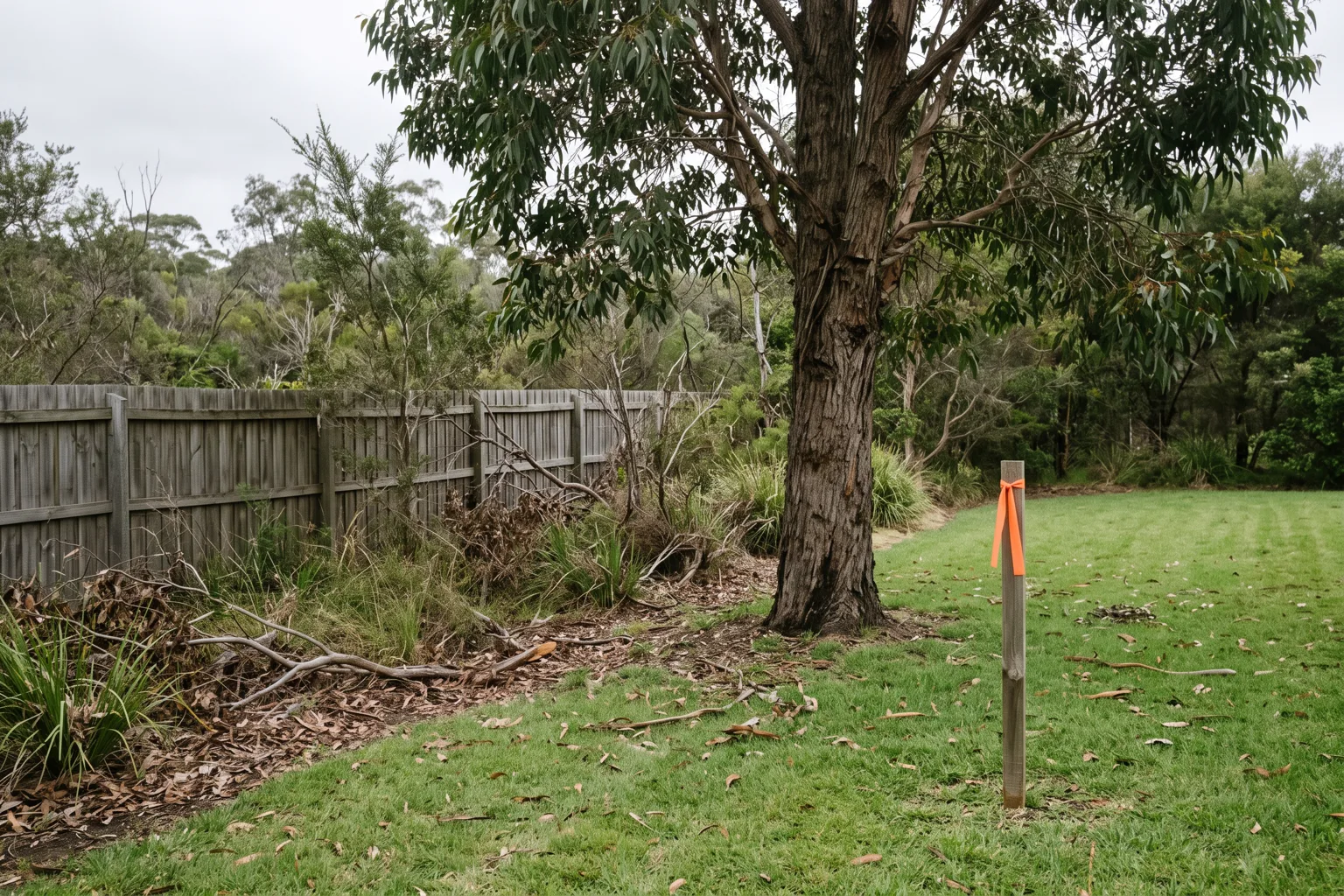
The 10/50 online tool tells you whether your land is in an entitlement area. It doesn't tell you, on its own, whether the specific tree you want gone is one of the categories the Code of Practice excludes outright: coastal wetlands, littoral rainforest, koala habitat, critically endangered ecological communities, Aboriginal places, and a separate 10-metre buffer around any lake or river two metres wide. A different SEPP covers clearing that has nothing to do with bush fire at all.
Our earlier piece on tree removal covers how to work out which of three instruments governs a given tree (the DA itself, a council permit under Chapter 2 of the Biodiversity and Conservation SEPP, or the RFS 10/50 scheme) and deliberately stopped short of listing the exemptions and exclusions inside each one, because a paraphrased exemption list is the thing people get wrong. Here is that list, in full, for the two regimes an urban block is most likely to run into.
Being in the entitlement area is not the end of the check
The 10/50 online tool tells you whether your land falls inside a 10/50 Vegetation Clearing Entitlement Area. It does not tell you, by itself, whether the specific tree you want gone sits inside one of the categories the 10/50 Vegetation Clearing Code of Practice excludes outright. The Code sorts those exclusions into three groups, based on how confident the RFS is in the underlying mapping.
The first group is mapped, and if your land parcel is wholly or partially inside one of these layers, clearing is excluded across the whole parcel: Coastal Wetlands, wetlands mapped under the Biodiversity and Conservation SEPP or the Hawkesbury-Nepean Regional Environmental Plan, littoral rainforest (outside its 100-metre buffer), specified koala habitat mapped in a Comprehensive Koala Plan of Management, Ramsar wetlands, any land within 100 metres of the NSW coastline or an estuary, Lord Howe Island, records of critically endangered plants, land mapped as critical habitat, and eight named critically endangered ecological communities including Cumberland Plain Woodland and Blue Gum High Forest, plus any other community the same mapping authority adds later.
The second group is also mapped, but the Code allows a rebuttal: national park estate, World Heritage land, and vegetation of high environmental significance identified under the Precincts SEPP's bio-certification are excluded where mapped, but if your parcel is flagged in error (mapped as national park when it isn't, say), the onus is on you to demonstrate that, and clearing isn't excluded for that reason once you have.
The third group isn't mapped in the online tool at all, and you won't see a flag for it: mangroves and coastal saltmarsh, as described in the Department of Primary Industries' own factsheets on each. If a tree sits in either, the Code excludes it regardless of what the tool shows.
A fourth exclusion sits outside all three groups and outside the mapping layer entirely, because it comes with its own definition of distance: an Aboriginal Place mapped by the former Office of Environment and Heritage, and separately, any Aboriginal scarred tree meeting the criteria in the department's own field manual. Neither may be cleared under the Code.
The 10-metre creek buffer that isn't the same 10 metres as the wall distance
This is the exclusion that trips people up on our kind of block, because it uses the same "10 metres" figure as the general clearing distance and means something different.
The Code's general rule lets a landowner clear vegetation within 10 metres of an external wall, and prune non-tree vegetation out to 50 metres. Separately, section 7.6 of the Code prohibits clearing, including trees, within 10 metres of a lake, or of a river that is two metres or more wide between the highest opposite banks, measured from the highest bank or, where there's no defined bank, the tidal limit. "Lake" is defined broadly enough to catch a wetland, a lagoon or a saltmarsh, whether natural or artificially modified, and "river" catches any watercourse and its tributaries whether perennial or intermittent.
Put the two rules together and a tree within 10 metres of your house and also within 10 metres of a qualifying watercourse sits inside both distances at once, and the watercourse buffer wins. The 10/50 entitlement doesn't override it.
Two more conditions that apply regardless of mapping
Slope and soil carry their own rule, independent of anything mapped. Tree removal under the Code isn't permitted on slopes steeper than 18 degrees, except in line with a geotechnical engineer's assessment done for that purpose. Pruning on a slope that steep is allowed only if at least 75% of the original canopy is retained, again subject to the same geotechnical sign-off. Separately, there's to be no disturbance of the soil surface, no removal of vegetation below the surface, topsoil has to stay in place, and heavy machinery designed to break the soil (graders, ploughs, bulldozers) can't be used to clear under the Code at all.
None of these exclusions or conditions are waivable by the fact that a tree also happens to be inside the entitlement area. The area determines where the scheme can apply at all. Every exclusion above then determines whether it applies to the particular tree.
The Code is a defence, not a permit
It's worth being precise about what clearing "under the 10/50 Code" actually gets you. Clearing carried out in accordance with the Code is treated as authorised clearing, which means a landowner isn't guilty of an offence for it. That's a different legal position from holding an approval. Anything the Code doesn't expressly provide for, such as dumping the vegetative waste afterwards, isn't authorised by it at all, and it's on the landowner to work out whether that other activity needs its own approval under a different Act. Clearing that strays outside the Code, even slightly, can be prosecuted under whatever instrument would otherwise have applied to it.
The consent requirement sits alongside this. Clearing can only be carried out with the landowner's written consent, and if a person is relying on a neighbour's house to authorise clearing on their own land, because their own home is too far away, they need that neighbour's written consent as well. The Code gives its own example: a tree more than 10 metres from the applicant's home but within 10 metres of two different neighbouring homes can only be removed if both neighbours agree in writing. A boundary tree straddling two properties needs every owner's consent before it comes down, not just the person who wants it gone.
The other SEPP: clearing that has nothing to do with bush fire
Chapter 2 of the Biodiversity and Conservation SEPP is the instrument for clearing that isn't linked to a DA, and Part 2.2 carries its own set of exemptions that are separate from anything in the 10/50 Code.
A permit or approval under Part 2.2 isn't required at all where the clearing is authorised under the Local Land Services Act's section 60O or Part 5B, though that carve-out doesn't extend to clearing that's ancillary to exempt or complying development. Nor is a permit required for removal the council is satisfied is a risk to human life or property, for a traditional Aboriginal cultural activity that isn't a commercial one, or for the removal of vegetation a council or the Native Vegetation Panel is satisfied is dying or dead and isn't required as habitat for native animals.
Section 2.8 goes a step further and lets clearing proceed without development consent at all, provided the clearing isn't ancillary to some other development, doesn't require a permit or approval under the chapter, and isn't a heritage item, an Aboriginal object, or vegetation sitting in a heritage conservation area or an Aboriginal place of heritage significance.
These tests are different from the ones in the 10/50 Code: no entitlement area, no wall distance, no watercourse buffer. They apply whether or not bush fire has anything to do with why the tree is coming out. A dead tree with no habitat value, or a council-approved hazard removal, can clear under Part 2.2 on land that was never mapped for 10/50 at all.
Checking a specific tree
Run the address through the 10/50 online tool first, on the day you intend to clear, and keep the printout. The RFS is explicit that the rules in force on that day are the ones that apply. Then check the tree itself against the exclusion categories above, independently of whatever the entitlement area map says, because the entitlement area and the exclusions are assessed separately. If there's a watercourse anywhere near the tree, measure the 10 metres from the highest bank before you measure the 10 metres from the wall. And if the tree isn't inside a 10/50 area at all, or the removal has nothing to do with bush fire risk, check it against Part 2.2 of the Biodiversity and Conservation SEPP before assuming a permit is needed.
Checking the vegetation mapping, the watercourse buffers and the council's tree controls before any design work starts costs nothing, and it's the check PropertyThrive runs on every property we assess. Ask for one and we'll come back to you within 24 hours.
Ready to get started with developing a property?
Get your development assessment or speak with our development experts today
24-Hour Response Guarantee
Submit your details and receive your preliminary development assessment within 24 hours, guaranteed.
No Obligation, Completely Free
Our assessment and initial consultation are completely free with no strings attached. Only proceed if you're 100% happy.
Strategic Development Partnerships
Partner with us to maximise development potential through joint ventures, profit-sharing, or direct acquisition options.