A development consent is not a yes. It is a yes plus a long schedule of conditions that decide what gets built, what it costs and when you are allowed to start. Some conditions are not legally valid, some mean the consent does not operate yet, and the NSW Government is part-way through making a set of them mandatory. Here is how to read the document you were sent.
An owner in Unanderra rang the week his consent came through, pleased, wanting to talk about builders. Detached dual occupancy, eleven months from lodgement, approved. Identifying details changed, as always.
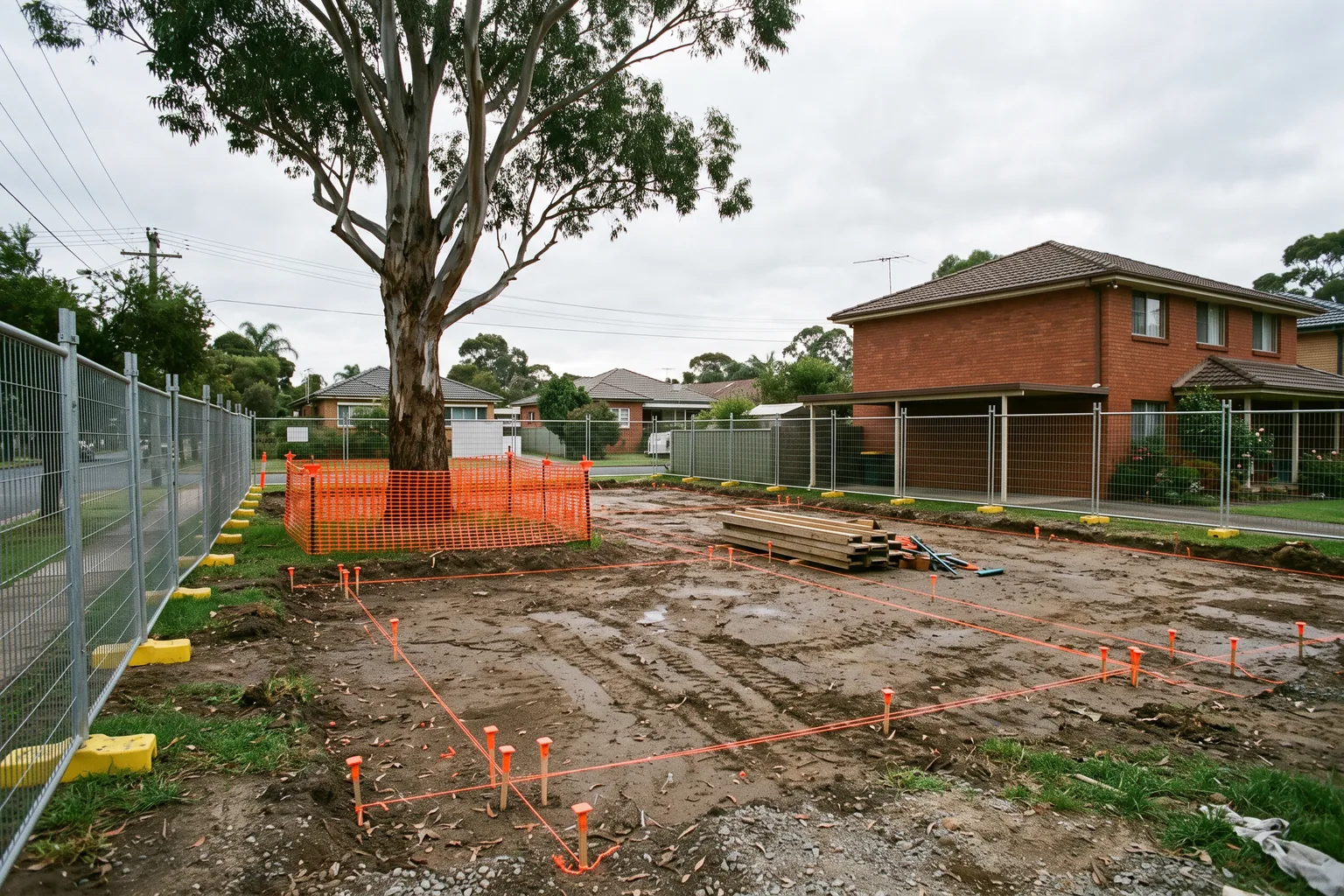
I asked him to send the notice of determination before he signed anything. It ran to fourteen pages. Sixty-odd conditions. Three of them mattered more than the approval itself: one required a tree protection zone that put the rear slab about two metres off where his designer had drawn it, one deferred the whole consent until he produced evidence of a stormwater easement over the neighbour's land, and one attached a contribution he had not costed.
He had read the first page. Most people read the first page. The first page is the part that tells you the least.
The consent is the conditions
The department's own framing is the honest one. Conditions of consent, it says, control and regulate the implementation and operation of approved development, and they provide certainty about the obligations that must be carried out throughout the life of the development, from the time consent is granted to when the development is used.
That is a much bigger claim than it looks. Not "during construction". The life of the development. A condition can bind what you do before you lodge a construction certificate, during the build, at occupation, and in some cases forever afterwards.
So the useful mental model is not approval-with-some-paperwork-attached. It is that the council has written the specification for your project, and the drawings you submitted are one input into it.
Deferred commencement, or the consent that does not exist yet
Start with the condition type that catches people hardest, because it is the one that sounds administrative and isn't.
A deferred commencement condition requires certain matters to be satisfied before the consent can operate. Not before you start work. Before the consent operates at all. Until you satisfy it and the council is satisfied, you are holding a document that has not yet become a development consent, and the consent authority may specify a period within which you have to produce the evidence.
The department's guide to writing conditions of consent tells councils these can be useful in certain circumstances but to impose them with caution, which is a fairly strong hint about how often they are imposed loosely. For an owner, the practical consequences are three.
Your project has no approval to sell, so a contract of sale that turns on development consent is not satisfied by a deferred commencement consent. Your finance is probably in the same position. And the matter you have been asked to satisfy is often the hardest thing in the file, because that is precisely why the council pushed it out of the assessment: easements over a neighbour's land, an agreement with an authority, evidence of a remediation outcome. My Unanderra caller's easement took four months and a payment to the neighbour, and it was the single largest risk in his project on the day he thought he had been approved.
If the word deferred appears anywhere in your conditions, that is the first thing to deal with and the number that governs your programme.
Not every condition is a valid condition
This is the part almost no owner knows, and it changes how you read the document.
A condition has to be lawful to be enforceable. The guide sets out two requirements: every condition must be authorised by the EP&A Act, particularly section 4.17, and it must satisfy the Newbury Test.
Section 4.17 is the framework for imposing conditions, and it covers the circumstances in which a condition may be imposed, conditions about ancillary aspects of development, conditions expressed as outcomes or objectives rather than prescriptions, conditions requiring the modification or surrender of consents or existing use rights, security arrangements, reviewable conditions, and conditions prescribed by the regulations. Conditions can also come from elsewhere: section 4.47(3) for integrated development, section 27(1)(b) of the Coastal Management Act 2016, section 7.13(3) of the Biodiversity Conservation Act 2016.
The Newbury Test is the interesting one. It comes from a 1981 case, Newbury District Council v Secretary of State for the Environment, and it says a condition must be imposed for a planning purpose rather than an ulterior one, must fairly and reasonably relate to the development that is the subject of the application, and must not be so unreasonable that no planning authority would have imposed it.
Three limbs, and each does work.
Planning purpose means the condition has to relate to a matter the EP&A Act expressly permits or implies, which in practice includes any relevant matter a council must consider when determining a DA under section 4.15. The guide's own illustration is a 2003 case where a condition required the applicant to negotiate with the council over the purchase of land for open space and drainage, and provided that if no price was agreed the council would compulsorily acquire it. The court found that was not a planning purpose, for a reason worth holding onto: the EP&A Act does not give a council the power to acquire land. That power sits in the Local Government Act 1993. The council was using a planning instrument to reach a non-planning outcome.
Fairly and reasonably relating to the development is about nexus, meaning a reasonably perceived connection between the condition and the environmental impact the condition is trying to mitigate. It is the same idea that governs contributions, and it is the limb that a condition requiring you to fix a problem you did not create tends to fail.
The third limb, unreasonableness, is a high bar by design and not the one to hang an argument on.
None of which makes challenging a condition quick. But it does mean that a condition you think is wrong is a question with an answer rather than a thing to accept. The route is usually a section 4.55 modification if you want the condition changed, or an appeal if you want it removed, and the notice of determination itself is required to state whether the applicant and any objector have a right of appeal against the determination.
The conditions that are really invoices
Two categories on every residential consent are money rather than design, and they are the ones that move a feasibility.
Contributions come first. A section 7.11 or 7.12 condition typically falls due before the release of a construction certificate or, on a subdivision, before the subdivision certificate is issued, which puts it at the wrong end of your cash flow rather than the start. We have written up how the two contribution mechanisms work, and the short version is that the condition on your consent is where the number stops being theoretical.
Then there is the long tail of conditions that carry a cost without naming one. Tree protection zones that constrain an excavation. A requirement for a particular stormwater treatment. Works in the road reserve. Acoustic treatment to a party wall. Landscaping bonds. None of these announce themselves, and collectively they are usually a bigger number than the contribution.
The discipline, and it is a boring one, is to go through the conditions with your builder before the contract is signed rather than after. Every condition that touches the physical work is either priced into the contract or it is a variation, and variations are where the margin goes.
What is changing, and what has not yet
Two separate things, and it is worth keeping them apart.
What already exists is a set of non-mandatory best practice conditions, previously called standard conditions, published by the department for residential development and for a handful of other categories. They are meant to give consistency for builders, developers, investors and certifiers working across multiple council areas, and the department's guidance is that consent authorities should not write their own condition where an applicable standard one exists. They are currently under review. They are not mandatory, and councils do write their own.
What is coming is firmer. The Environmental Planning and Assessment Amendment (Planning System Reforms) Act 2025 introduced the ability to impose standard and model conditions, and the department states that when those changes come into effect, certain conditions will be made mandatory. The detail sits in an Explanation of Intended Effect. The important qualifier is the tense: the ability exists in the Act, the mandatory conditions do not bite yet, and the best practice conditions are being reviewed for integration with the reforms rather than replaced by them.
If someone tells you your council must use a standard condition today, they are describing where this is heading, not where it is.
There is one change that has already landed and quietly helps. For development applications lodged on or after 30 June 2023, councils have had to use the standard format notice of determination on the NSW Planning Portal for local DAs, and when exercising consent authority functions of a Sydney district or regional planning panel on behalf of the panel. Consents from different councils now look broadly alike, which makes them easier to read side by side than they were three years ago.
Four things to check on the day it arrives
Read the dates first. The notice has to state the dates from which the consent operates and when it lapses. Those two dates are your programme, and if the first one is conditional you are in deferred commencement territory whatever the covering email said.
Read the list of approval bodies. The notice has to identify the approval bodies that have given general terms of approval, which tells you whether another agency was in your file at all, and if so, that your consent conditions must be consistent with what that agency required. If that is unfamiliar ground, who else gets a say in your DA sets out how those approvals work.
Read the money conditions and add them up, including the ones that only imply a cost.
Then read every condition that constrains the physical work, with your designer, against the drawings you are about to build from. My Unanderra caller's tree protection zone was condition 41 of 63. It moved a slab. Nobody found it until the engineer was already drawing footings, and the redraw cost more than the arborist would have.
An approval is a good day. It is also the first day you can be certain what you are actually allowed to build, which is not always the thing you applied for.
PropertyThrive reads the conditions on every project we assess, before the feasibility is finalised, because a consent with a deferred commencement condition and a consent without one are different assets. If you're holding a determination and you aren't sure what it commits you to, ask us to look at it and we'll come back to you within 24 hours.
Ready to get started with developing a property?
Get your development assessment or speak with our development experts today
24-Hour Response Guarantee
Submit your details and receive your preliminary development assessment within 24 hours, guaranteed.
No Obligation, Completely Free
Our assessment and initial consultation are completely free with no strings attached. Only proceed if you're 100% happy.
Strategic Development Partnerships
Partner with us to maximise development potential through joint ventures, profit-sharing, or direct acquisition options.