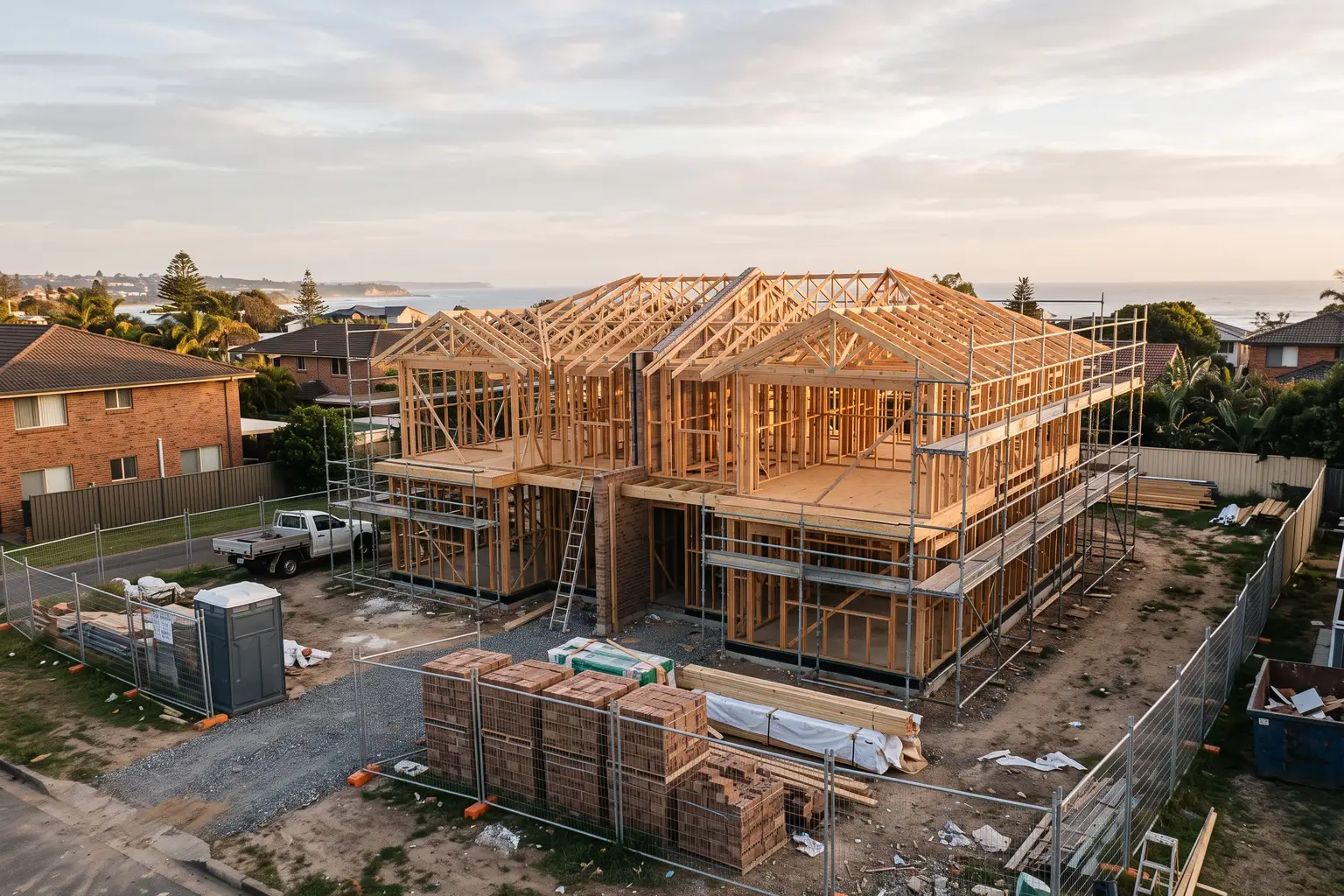
How to Finance a Dual Occupancy in NSW: What the Lender Is Actually Lending Against
A dual occupancy is financed against three things the owner rarely separates: the land they already hold, a fixed-price building contract, and a valuation of two dwellings that don't exist yet. Which of those the lender leans on, and whether it treats you as a homeowner or a developer, is decided by your exit, not your postcode. A worked example on an R2 block in Corrimal, with the figures kept inside our published ranges.
The feasibility on a dual occupancy is usually fine. The finance is where it gets stuck, and it gets stuck for a reason that has nothing to do with the numbers on the page.
An owner in Corrimal sent me a feasibility in August that I'd have signed off on. Owned the house outright, R2 block of 640 square metres with a bit over 15 metres of frontage, clean 10.7, a detached pair that fitted the low and mid-rise standards. Costs sat mid-range. The problem was the sentence at the bottom of the email: "the bank said no". Not no to the project. No to the version of the project he'd described, which was build two, sell two, and clear the mortgage. Same block, same drawings, described as build two, keep one, sell one, and the answer would have been different, because the lender would have been looking at a different borrower.
That's the whole subject, really. Before you talk to anyone about rates, get clear on what you're asking them to lend against, because there are three candidates and they behave differently.
Three things a lender can lend against, and only one of them exists
The first is the land you already own, or more precisely the equity in it. For most owners contemplating a dual occupancy this is the entire reason the project stacks up, and I've said before that the landowner sits in a genuinely different position from a developer who has to buy the site at retail. The equity is real, it's already valued, and it's what gets a lender past the first conversation.
The second is the building contract. A fixed-price contract with a licensed builder is a document the lender can read, and it's the basis of every drawdown. NSW requires a written contract for residential building work over $5,000, and Fair Trading's contracts guidance sets out that jobs over $20,000 need the more extensive large job contract. A lender won't fund a build on a quote, and it won't fund against a cost-plus arrangement without a lot more equity in the deal. The contract stages become the progress claims, and the progress claims become the drawdowns. If your builder's contract has five stages, your loan will have five drawdowns, and the lender will generally want its own inspection before each one.
The third is the end value, and this is the one that doesn't exist yet. A lender commissions a valuation of the two dwellings "as if complete", and it's that figure, discounted by whatever proportion the lender's policy allows, that caps the loan. I've been through why a valuation and a feasibility are different documents: the valuer is looking backwards at comparable sales, not forwards at your margin. If the valuer's as-if-complete number comes in under the number in your feasibility, the loan shrinks and the gap comes out of your pocket. It's the most common surprise in this process and it's entirely predictable, so get a valuer's view of the end product before you commit to the design, not after.
Homeowner or developer? Your exit decides
Here's the bit the Corrimal owner ran into.
Lenders divide the world into residential lending, which is what your home loan is, and commercial or development lending, which is a different desk with different pricing, different paperwork and a different appetite. Which desk you land on isn't decided by the fact that you're building two dwellings. Plenty of owners build a dual occupancy under an ordinary construction home loan. It's decided, in my experience, by what you've told them you're going to do at the end.
Build two, keep both as rentals or live in one and rent the other, and the lender is looking at an owner-occupier or an investor with a slightly unusual house. The security is one title with two dwellings on it, the income is rent or wages, and the loan is assessed the way a home loan is assessed, on your capacity to service it. That's the version most owners can get financed at a home-loan rate.
Build two, sell both, and you've described a development. Now the lender is being asked to fund a project whose repayment comes from sales that haven't happened, to a borrower whose income doesn't service the debt on its own, and the conversation moves to the development desk, where the questions are about presales, margin on cost and your track record. That desk exists and it will fund good projects. It just funds fewer of them, more slowly, at a higher price, and the margin it wants to see is around twenty per cent on cost, which is a hurdle a thin attached pair in a mid-priced suburb often can't clear.
The Corrimal owner had described the second version and been assessed as a developer, with a thin margin, and been declined. He was in fact intending to keep one and sell the other, which is the middle case: assessed as residential by most lenders I've dealt with, provided the retained dwelling and his income carry the residual loan after the sale. Same project. Different answer. I'm not suggesting anyone misdescribe their intentions to a lender, which is a good way to end up with a loan you can't service and a lender who has grounds to call it. I'm suggesting you decide your exit honestly before you apply, because the exit is the application.
There's a tax edge to this too, and it's the same one. The ATO's own guidance says you may need to register for GST, even if you aren't a business, where your activities are regarded as an enterprise, giving the example of someone who buys "land with the intention of developing it for resale at a profit", and adds that "even a one-off property transaction may be considered an enterprise". Building two on land you've held for decades isn't that fact pattern exactly, but sell both and it's close enough that the question gets asked. I've written about how CGT and GST treat a subdivision elsewhere and I'm not an accountant, but the point for finance is that the same sentence you say to the bank is the sentence you're saying to the ATO, and both of them are listening.
What the loan looks like while you build
A construction loan, whichever desk writes it, is drawn in stages against the builder's progress claims and charged interest only on what's been drawn. So the interest bill starts small and grows through the build, which is why our dual occupancy cost guide budgets construction loan interest as a range rather than a rate times a balance: $30,000 to $50,000 across a twelve-month build, on the guide's assumptions, with the total finance and professional line at $60,000 to $110,000.
During the build the loan is almost always interest-only. That's sensible, because there's nothing to repay yet. What owners miss is what happens after. On a keep-both exit the loan converts to principal and interest at the end, and MoneySmart's plain warning on interest-only loans applies word for word: "make sure you can afford higher repayments at the end of the interest-only period". Run that repayment now, on the full drawn balance, at a rate a bit above today's. If it doesn't work on your income plus a realistic rent for the second dwelling, the keep-both exit doesn't work and you're back to a sale, which puts you back on the other desk.
The other thing the lender controls during the build is timing. Every drawdown waits on an inspection, and every inspection waits on the builder's claim being lodged in the form the lender wants. A builder who has done this before knows the rhythm. A builder who hasn't can cost you a fortnight per stage, and on a twelve-month build that's real interest.
The Corrimal block, worked through
Identifying details changed as usual, and every dollar figure is a point inside a range already published on this site. The block is R2, 640 square metres, a touch over 15 metres wide, a three-bedroom weatherboard from the sixties, no mortgage. Appraised as it stood at $850,000, which is the figure our duplex post and case study both use. The proposal is a detached dual occupancy at the rear with the existing house retained and refreshed, which keeps the demolition line off the budget, and the owner's honest exit is keep the front house, sell the rear.
Project cost, using the guide's ranges: construction for one new detached dwelling at the lower end of the detached band, contributions and connections at the guide's midpoint, finance and professional fees at the guide's lower end because the build is one dwelling not two, plus a modest refresh on the front house and a Torrens subdivision. Call it $700,000 all in. That sits just under the guide's $741,500 to $1,173,000 range for a detached pair, which is what you'd expect when only one of the two dwellings is being built.
The as-if-complete valuation is what decides the loan. A valuer looking at comparable sales in the suburb puts the new rear dwelling at $900,000, our standard figure, and the refreshed front house at $800,000, for $1.7 million across both titles. The lender's policy discounts that, and the loan is capped at a proportion of it. I'm not going to quote a loan-to-value percentage here, because it varies by lender, by product and by month, and any number I put in print will be wrong for someone. What I'll say is that on these figures the owner needed to borrow $700,000 against $1.7 million of completed security with no existing debt, and that's a conversation every residential lender will have.
Serviceability was the real test. During the build, interest only on a growing balance, funded from his wages. After the sale of the rear dwelling, roughly $900,000 gross less selling costs, subdivision and the loan, he clears the debt and holds the front house unencumbered, which is a materially better position than the case study owner ended in, because he kept the land value in the retained house rather than realising it at a thin margin. Had he wanted to keep both, the residual loan of $700,000 on a principal and interest basis would have needed his income plus a rent on the rear dwelling to carry it, and that's the MoneySmart calculation, not mine.
Note what didn't feature: no mezzanine debt, no private lender, no presale requirement, no GST registration. All of that arrives the moment the exit becomes sell both, and it's why I'd rather an owner tell me their honest exit in the first meeting than the one they think sounds ambitious.
Where finance sits in the sequence
Talk to a lender, or a broker who does construction lending regularly, after the concept design and the first-pass feasibility but before the DA. Not before the design, because there's nothing to value. Not after the consent, because you'll have spent the approval budget on a scheme a valuer might mark down. The feasibility study cost post sets out the sequence of who to pay when, and the lender's indicative view belongs in the same window as the valuer's.
Then decide the exit, write it down, and build the finance around it. Keep both, keep one, sell both. Each is financeable. They're just not financeable by the same people, on the same terms, at the same margin, and the owner who works that out before the application is the one who gets a yes.
If you'd like this run on your block with your council's figures and an honest view of which desk you'd be talking to, ask for an assessment. It's free, and if the answer is that your project only stacks up on the development desk, you'll hear that before you've spent anything.
Ready to get started with developing a property?
Get your development assessment or speak with our development experts today
24-Hour Response Guarantee
Submit your details and receive your preliminary development assessment within 24 hours, guaranteed.
No Obligation, Completely Free
Our assessment and initial consultation are completely free with no strings attached. Only proceed if you're 100% happy.
Strategic Development Partnerships
Partner with us to maximise development potential through joint ventures, profit-sharing, or direct acquisition options.